
Great Lakes Icebreaking Update
Including an overview of the St. Lawrence Seaway (which had its latest closure ever because of early ice buildup) and a look at what icebreaking operations look like during the "closed" season.

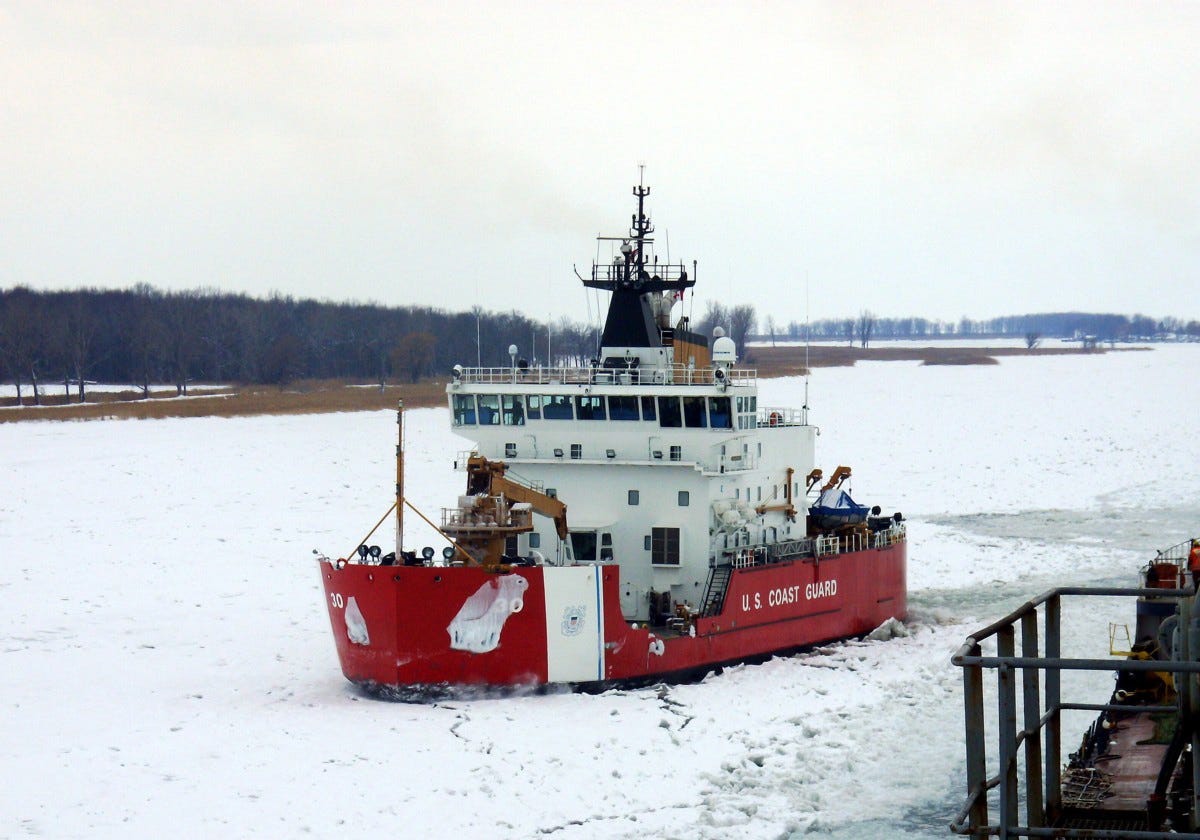
January 2: Operation Coal Shovel Begins
From a U.S. Coast Guard press release:
DETROIT — Coast Guard Sector Detroit commenced Operation Coal Shovel to prevent newly formed ice from hindering commercial vessel traffic on Friday, Jan. 2, 2026.
Operation Coal Shovel is a domestic ice-breaking operation with an area of responsibility spanning from southern Lake Huron to the St. Clair-Detroit River system and into Lake Erie and Lake Ontario, including the St. Lawrence Seaway.
U.S. and Canadian Coast Guard icebreakers work together in these waterways as conditions worsen throughout the winter to ensure the ability to conduct Search and Rescue and flood mitigation and facilitate navigation to meet the reasonable demands of commerce.
Additionally, other emergency operations include opening channels to icebound communities or breaking ice for the vessels that serve them to ensure the critical supply of food and heating oil and access to medical assistance is maintained.
Sector Detroit provides command and control for Operation Coal Shovel and may place restrictions or close waterways as ice conditions dictate. Due consideration is given to the need for cross-channel traffic such as ferries and the safety of island residents, who use naturally formed ice bridges for transportation to and from the mainland.
January 13-15: St Lawrence Seaway and Soo Locks Closed
The last transit of the Welland Canal took place on January 13th before closing for the season. This is the latest ever closure of the St. Lawrence Seaway, a system of locks and canals that connects the Great Lakes with the St. Lawrence River, since the seaway opened in 1959.
The Montreal to Lake Ontario (MLO) locks were originally scheduled to close on January 5th, and the Welland Canal on January 10th. However, early ice conditions slowed the passage of ships, delaying the closure. On January 8th, North Country Public Radio reported:
There are massive ships stuck in the St. Lawrence Seaway. Ice is building up around the locks between Lake Ontario and Montreal, making it difficult to impossible for ships to get through.
The severe winter weather has indefinitely delayed the end of the Seaway’s navigation season. It was set to close on Monday, Jan. 5.
…
[T]he lock workers have been going non-stop. Kudos to them. They've done a heck of a job. The work that they're doing is scraping the sides of the walls with heavy machinery. They bring in steam to melt the ice. They've had folks on booms trying to chip ice off of lock gates. They're doing as much as they possibly can. The other work that's being done is there are tugboats, especially downriver near the South Shore Canal. There are tugboats that are doing a lot of ice breaking in the canal. What they'll do is they'll lock through. Lock through is where they come in, push the ice in with them, the lock lowers, and they push the ice out so it can continue to move downbound.
The last paragraph comes from NCPR’s interview with Michael Folsom, who runs the Seaway Ship Watchers Network. He provides excellent information about what’s going on in the Great Lakes. If you’re interested in shipping through the Great Lakes and St. Lawrence Seaway, he’s definitely worth following on X.
The backlog of vessels was eventually cleared, and the MLO finally closed on January 12th, with the Welland Canal’s closure following on January 13th.
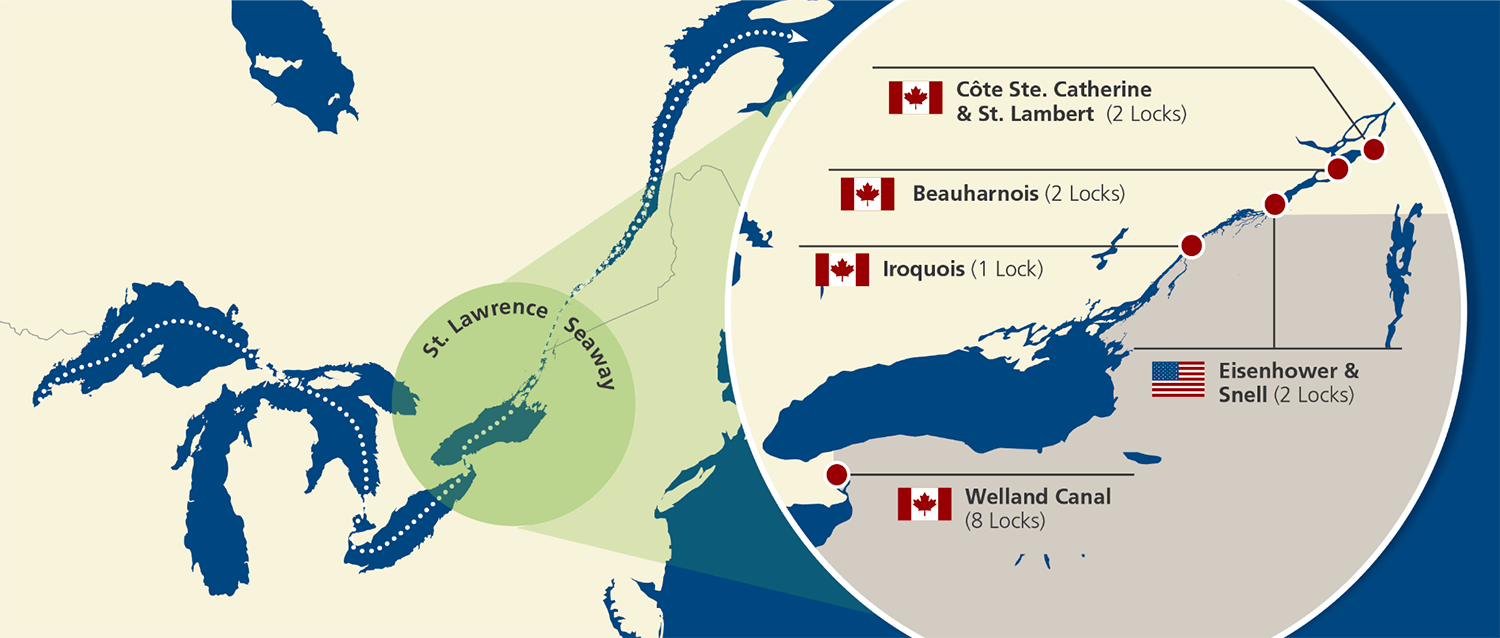
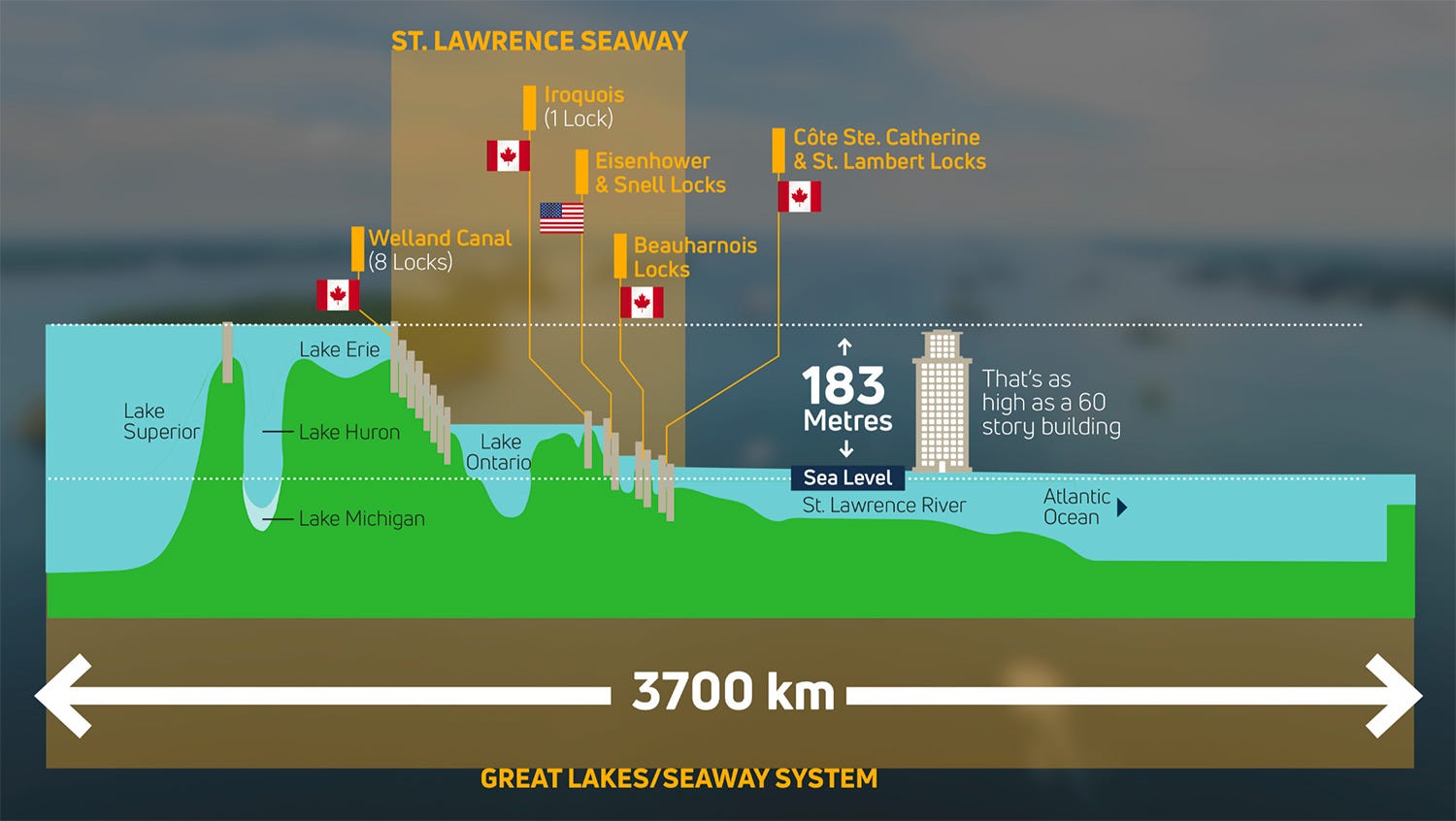
The St. Lawerence Seaway has two sections:
Welland Canal Section (consisting of eight locks) was completed in 1932.
The Montreal – Lake Ontario Section (consisting of seven locks) was completed in 1959.
The combination of these two sections forms the St. Lawrence Seaway, which permits ships to transit between “sea level in Montreal to Lake Erie.
The St. Lawrence Seaway and the Soo Locks, which connect Lake Huron with Lake Superior, enable ships to transit the 3,700km from the Atlantic Ocean to the head of Lake Superior.
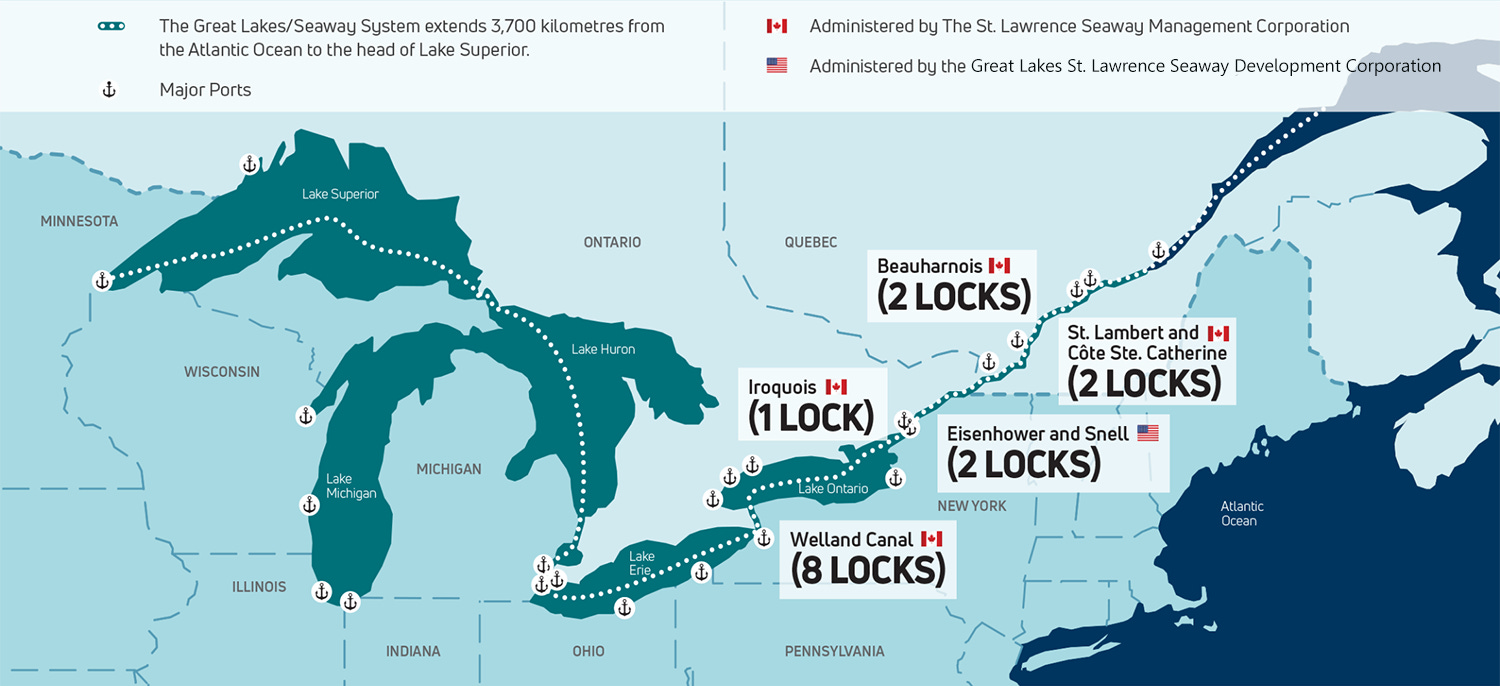
The Soo Locks, operated by the U.S. Army Corps of Engineers, closed on January 15th for their regular winter maintenance period.
The locks enable vessels to transit from the lower St. Lawrence River, which is at sea level, to Lake Superior, 600 ft (or 183 m) above sea level:
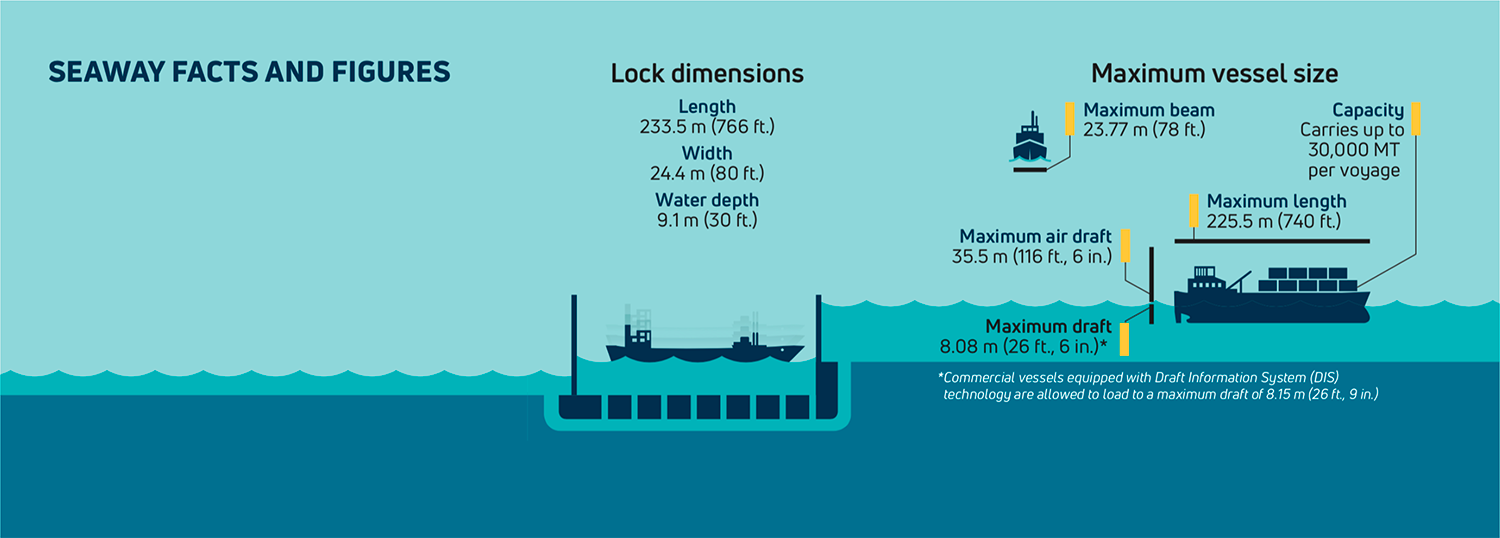
It is the size of these locks that limit vessels transiting to/from the Great Lakes to a maximum size:
The Soo Locks are scheduled to re-open on March 25th. The St. Lawrence Seaway typically re-opens in mid-March.
For more information about the Great Lakes and St. Lawrence Seaway, be sure to visit The Seaway - Great Lakes St. Lawrence Seaway System, the source of these excellent graphics. For a great video concerning the closing (and operation of) the St. Lawrence Seaway, be sure to visit Sal Mercogliano over at What’s Going on With Shipping:
Great Lakes and St. Lawrence River Icebreaking Continue After Closure of Locks
After the closure of the St. Lawrence Seaway and Soo Locks, Great Lakes traffic slows and essentially stops until March as the vessels head towards their winter ports. This does not mean an end to icebreaking. Operations Taconite and Coal Shovel continue, as does icebreaking along the St Lawrence River.
Operation Taconite During Closed Season
Here is a description of Operation Taconite during this phase of the season, from the U.S. Coast Guard:
OPERATIONS DURING THE CLOSED SEASON (LOCKS CLOSED):
Primary area of operations: Straits of Mackinac. Traffic consists of tanker vessels carrying fuel oil and tug/barge traffic carrying petroleum products. Ice conditions in the Straits of Mackinac are extremely weather-dependent. The ice tends to go wherever the wind blows. Strong winds pile-up the ice, creating areas of thick ice and "pressure ridges" which can have "sails" and "keels" measuring several feet (4-6 feet is common).
Due to these volatile conditions, it is imperative that we keep track of scheduled vessel transits. Prior to all known transits we conduct track maintenance through the Straits of Mackinac out to Lansing Shoal. Additionally, when cutters are not actually breaking ice, they remain in a standby status -- ready for quick response. Two 140' WTGB's [Bay-class Icebreaking Tugs] or CGC Mackinaw are kept on standby at all times.
Due to the environmental threat posed by the cargos of many of the transiting commercial vessels and the potential for extremely hazardous ice/wind conditions in the vicinity of the Straits, this is a potentially very dangerous portion of our icebreaking operations. In the past we have used Captain of the Port authority to restrict vessel transits through this area due to extreme ice/wind conditions.
Secondary area of operations: St. Mary's River. Several times during the period when the locks are closed, we provide direct assistance to tanker vessels transiting upriver to Sault Ste. Marie, Ontario. These vessels provide the fuel oil for the town during the winter.
Closed areas: Once significant ice has formed and after the locks close, Captain of the Port Sault Ste. Marie closes five areas to navigation due to dangerous conditions and/or to aid in the formation of ice bridges: Grays's Reef Passage ,South Channel, the waters between Mackinac Island and St. Ignace, Pipe Island North and East Channels and the West Neebish Channel.
(Line breaks and bold added for readability)
Operation Taconite began on December 10th, as noted in my December U.S. Coast Guard Roundup:

The busiest part of the season for these icebreakers will be when traffic resumes in March, as there will still be significant ice coverage on the Great Lakes.
Canadian Icebreaking Operations Continue in St. Lawrence River
For an overview of operations in the St. Lawrence River, I suggest watching this 5:42 video from the Canadian Coast Guard:
In short, the Canadian Coast Guard continues to operate in the St Lawrence River to ensure safety and keep traffic flowing from the Gulf of St. Lawrence to the port of Montreal. To do so, it performs these tasks:
Escort vessels
Free ports trapped in ice
Free ships trapped in ice
Maintain navigable channels
Prevent flooding
The video describes flood prevention as the most important task:
For us in icebreaking, another emergency situation is flood control. In some areas of the river, like in Quebec City and Trois-Rivières, the ice can simply stop moving, during a tide change, the ice accumulates under the water and can create jams.
At that point, it can flood communities upstream of the jam. So icebreakers absolutely need to be deployed to get the ice moving again or to break up the jam.
(YouTube transcript)
January 20: U.S. Coast Guard Assists American Spirit in Lake Erie (Operation Coal Shovel)
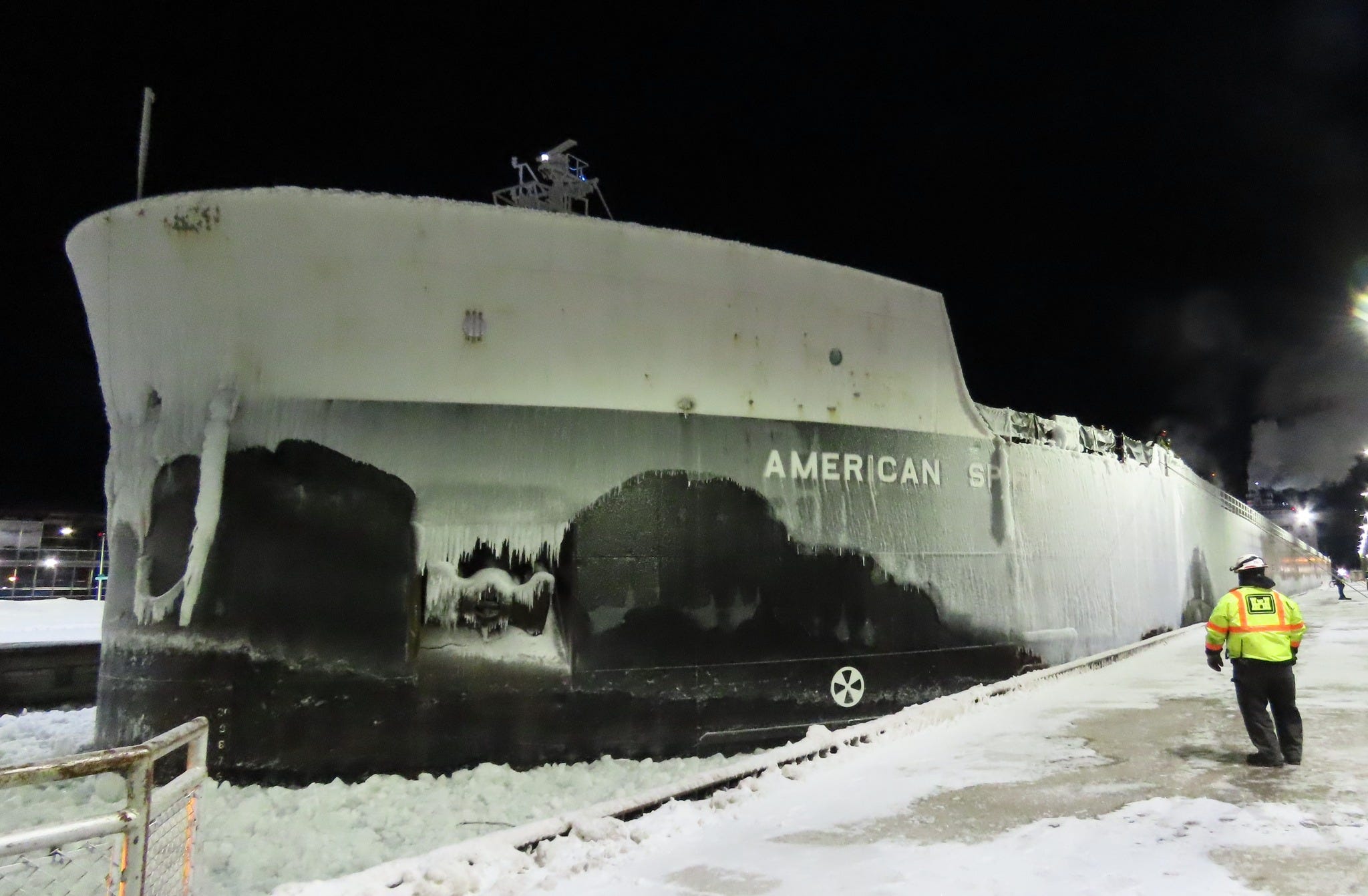
American Spirit, mentioned above as the last vessel to transit through the Soo Locks, required assistance in Lake Erie on January 20th. Here is a newsclip from WTOL 11, the Toledo, Ohio based CBS affiliate:
American Spirit was assisted by the Bay-class tugboat/icebreaker Neah Bay as part of Operation Coal Shovel. For more information about the Bay-class, see here:

One detail from the report stuck out to me: On January 14th, Lake Erie had only 1% ice coverage. By January 20th, 76% of Lake Erie was covered with ice, an addition of 7,527 square miles of ice in just six days!
The Need for Additional Domestic Icebreakers
As I reported in the December U.S. Coast Guard Roundup, the U.S. Coast Guard is looking to expand its domestic (i.e. Great Lakes) icebreaking fleet by adding 18 new icebreaker— ten Homeland Security Cutter-Mediums (HSC-Ms) to replace the Bay-class, and seven Homeland Security Cutter-Light (HSC-Ls) to replace its aging 65-foot light icebreaking tugs (WYTLs) and 49-foot buoy utility stern loading boats (BUSLs). There is also a U.S. Coast Guard web page for a Homeland Security Cutter-Heavy (HSC-H), a vessel designed to augment the Great Lakes heavy icebreaker Mackinaw , although there is (as of today) no official Request for Information (RFI).
This year’s delays point to a need for more icebreaking capability in the Great Lakes and the St. Lawrence Seaway. The American Maritime Officers Union describes the recent situation in a January 20th post:
[S]hippers and industry groups reported that ice formation, while not extreme this season, arrived earlier than anticipated in December and caused significant disruptions….
Critics of the icebreaking response pointed to the USCG’s delayed completion of the annual removal of floating aids to navigation before ice could damage or displace them. This mission, which took priority, delayed the deployment of icebreaking assets to assist commercial traffic, including holding back the USCGC Mackinaw until buoy removal was finished.
The Lake Carriers’ Association highlighted the fact that the USCG’s fleet of nine ice-capable vessels is stretched thin, with two dedicated to buoy maintenance and others affected by mechanical issues. The absence of additional heavy icebreakers and the aging 140-foot tug class have left the service struggling to balance navigational-aid removal with timely icebreaking support.
The Union also noted that the Canadian Coast Guard has not played a role on the Great Lakes proper this year:
The Canadian Coast Guard had not deployed any icebreakers on the Great Lakes proper this season, with two vessels operating in the St. Lawrence near Montreal and a third docked in Sarnia, Ontario, due to engineering problems. U.S. vessels calling at Canadian ports continue to pay icebreaking fees despite receiving no assistance from CCG assets.
The Canadian Coast Guard also has plans to renew its fleet, as I wrote about here:

There is some difference in how the U.S. and Canadian Coast Guards consider their icebreaking fleets. For the U.S., Great Lakes icebreakers are considered domestic icebreakers, while the Canadians consider them light icebreakers. Often, the Canadian light icebreakers are considered in national icebreaker counts, while the U.S. domestic icebreakers are excluded. This is probably because Canada does use their light icebreakers outside of the Great Lakes.
Interestingly, the Canadian Coast Guard plans on replacing its older light icebreakers with the Multi-Purpose Icebreaker (previously called the Multi-Purpose Vessel). According to the Canada’s National Shipbuilding Strategy, the missions of the MPIs include:
icebreaking in the Arctic in moderate ice conditions
assisting with shipping and springtime flood control in the St. Lawrence waterway and Great Lakes regions
conducting missions involving search and rescue, emergency response, and security and protection
maintaining Canada’s marine navigation system, composed of approximately 17,000 aids to navigation
The U.S. Coast Guard is acquiring six Arctic Security Cutters that use the MPI design. It will be interesting to see if any of those vessels end up operating in the Great Lakes.


Thoughts and Comments
I picked quite an interesting time for my first full article on Great Lakes icebreaking, as the scheduled late closing of the St. Lawrence Seaway required an extension due to early ice conditions.
To be clear: this record season was not because of a longer ice-free season, but because early ice disrupted the scheduled flow of ships through the locks, requiring additional time to clear away ice so that these scheduled transits could be completed.
NCPR also reported that some ships abandoned their transit plans will instead winter in the Great Lakes (with cargo):
[S]ome Canadian vessels, that had planned to transit the St. Lawrence and head toward Montreal, abandoned their voyage and returned to Hamilton, Ontario because it was going to be less costly for them to keep the cargo they had on board and winter that ship on the Great Lakes than sit and wait in hopes of getting to their destination and not really knowing how much money could be lost between the time they sat and the time they arrived. Those ships will likely sit in Hamilton with their cargo still on board. So once the opening comes in the spring, they can get on their way and get that stuff delivered.
I’ll be following the Great Lakes for any notable news or operations during the winter closure and will cover the re-opening and associated activity when it happens in March.
Thanks for reading. Many of you probably know more about Great Lakes icebreaking than I do, so I’m looking forward to your feedback and questions.
Don’t forget to like if you appreciate coverage of the Great Lakes.
Also, remember to subscribe and share.
Until next time,
All the Best,
PGR
Related articles:
Well done, as always. I will send this to my brother in law who was US Coast Guard in the early 70s. He worked mostly Wisconsin and Michigan.
As someone living downwind of Lake Erie in the Buffalo area, the lake's ice coverage is widely followed. Heavy snow squalls from the lake can impact travel.
Once ice covered, Lake Erie snow squalls diminish considerably. Lake Ontario, on the other hand, is much deeper than Erie and never freezes over. So lake effect snow squalls west of Lake Ontario are more severe. Snow accumulation of 1-2 feet per day is common in areas around Watertown NY.